

Leave the drawer open
23 October 2026
In his latest column, Founder of ICONIC, James Kirkham, asks if AI files everything instantly, where do unfiled ideas go?
Everything gets filed now. A photo pops into your camera roll instantly dated, tagged, scanned for faces, and all ready to be served back to you as a "memory" on a random Tuesday morning by software you never asked it to do. This is especially awkward I find when you’re divorced and absolutely not appreciating those surprise holiday snaps from 2014.
Things like this happen all the time. That note which goes into an app that wants to know which project it belongs to before it will let you type. Or maybe that song thats already been sorted into one of thousands of micro-genres your friendly streaming service uses to decide what you hear next. Basically nothing waits anymore. Every item has a home the second it arrives, picked by something other than us.
Then there is the drawer in your kitchen. Come on, most of us have one, don’t pretend you don’t. Is contains some batteries of unknown charge, a fuse, three keys nobody can identify, and a tube of glue gone hard. We call it the junk drawer, which undersells it badly, as it holds the things that have no category but becomes weirdly essential just when you need them the most.
The drawer works because it is where sorting stops, you put the thing in, close it, and it waits, sometimes for years in my case, until the odd fuse or the third key turns out to be precisely what you need. You find it because you remember the drawer, and the filing system never had to know.
However, marketing has spent the best part of two decades emptying its drawers.
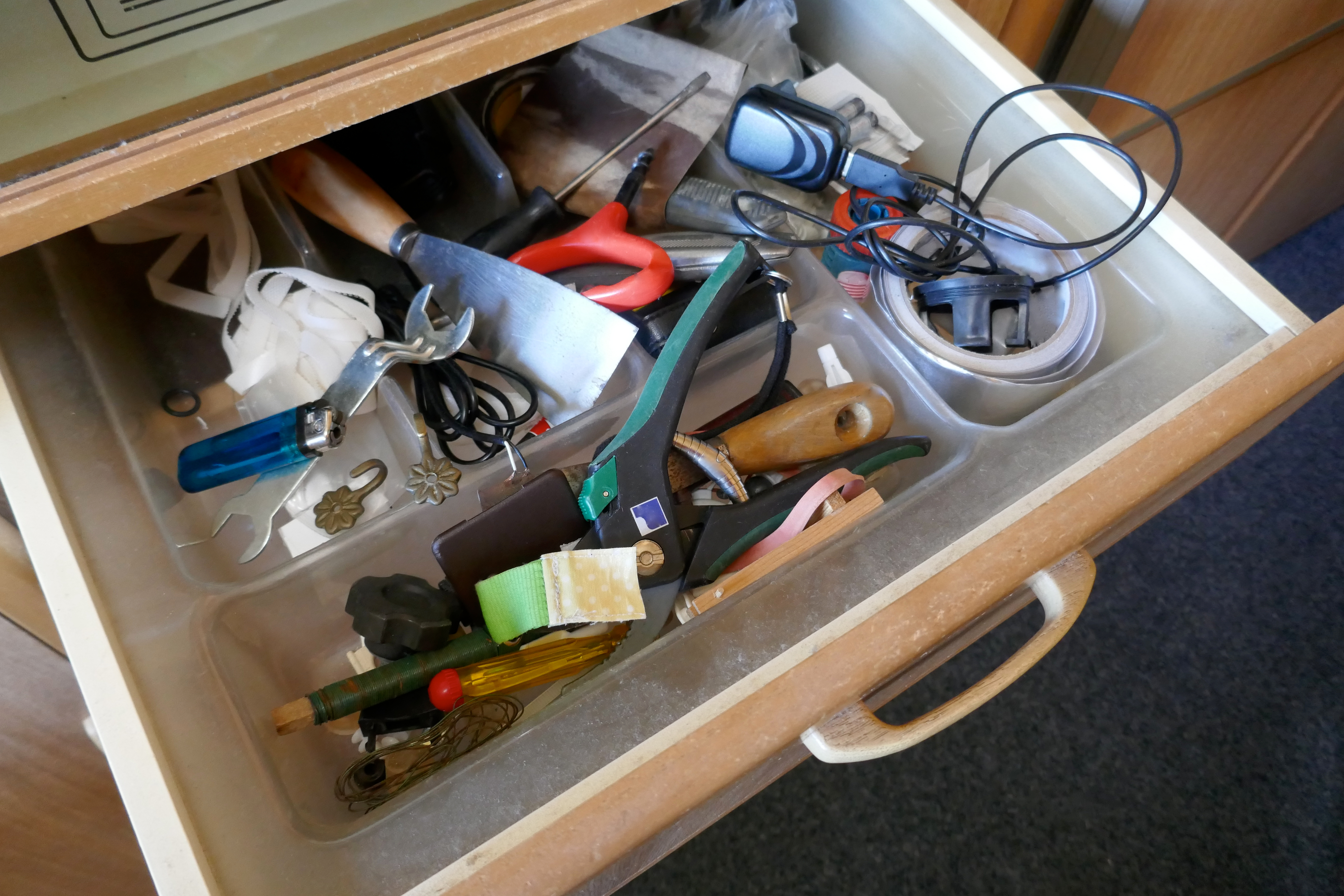 Be honest, everyone's got a drawer like this!
Every idea now has to arrive with an address, to ladder up to a pillar or map to a funnel stage and carry a KPI before it is allowed in the room. AI speeds all of this up beautifully of course so we hand a tool a pile of research, social listening and half-formed ill conceived spoken thoughts and it will return them clustered and summarised in seconds. Every line assigned to a theme.
That is genuinely useful and it carries a cost that never shows up because whatever doesn't fit gets forced into somewhere it doesn't belong, or dropped but the history of good ideas is full of things that sat unfiled.
In 1968 a scientist called Spencer Silver made an adhesive that was too weak to be much use - it stuck, but only just, and it peeled away without a trace. For years it had no application and Silver kept talking about it to anyone in the company then a colleague, Art Fry, got fed up with the bookmarks falling out of his hymn book at choir practice and remembered the glue nobody wanted. The Post-it Note went on sale across the US in 1980.
The weakness of the glue was the whole point of it, and it took twelve years and some sweet people inside of a random church choir to see it. Silver's adhesive survived precisely because 3M let it sit in the company's equivalent of a drawer. A modern workflow would have logged it as a failed experiment and closed the ticket on it though.
The useful question for brands and agencies right now is where the drawer lives in their own org? Where does the half-sentence overheard on the bus go? Or the photograph of a shop sign in Lisbon, the odd comment under a competitor's post, the feeling about a product or category that nobody can yet put on a slide?
If the only places to put things are the ones the system recognises, then the system is deciding what counts as an idea. A system that only recognises familiar shapes will keep handing back the sameness and algorithmically identical crap. It’s exactly what everyone at MAD//Fest spent July rightly worrying about in culture, adland and the brand marketing world these days.
The best teams keep something like a drawer on purpose now but likely more in the form of a shared channel with no rules or better still a wall of pinned scrap notes nobody is allowed to tidy away.
There is a discipline to this for us all, (and tricky for the tidying / OCD crowd like me), which means resisting the urge to resolve everything. We need to be better at tolerating a pile of things that may come to nothing, and trusting that a few will turn out to be exactly what a brief needs 18 months from now.
Taste is mostly knowing what to keep before you know why, so make sure you leave the drawer open.


