

Six Slices interview: Brian MaCreadie, Head of Marketing, Addleshaw Goddard
17 November 2026
Six questions. Six bite-sized answers. In this week’s interview, Addleshaw Goddard’s Head of Marketing makes the case that there is no marketing playbook and copying proven formulas can’t replace understanding your unique market context.
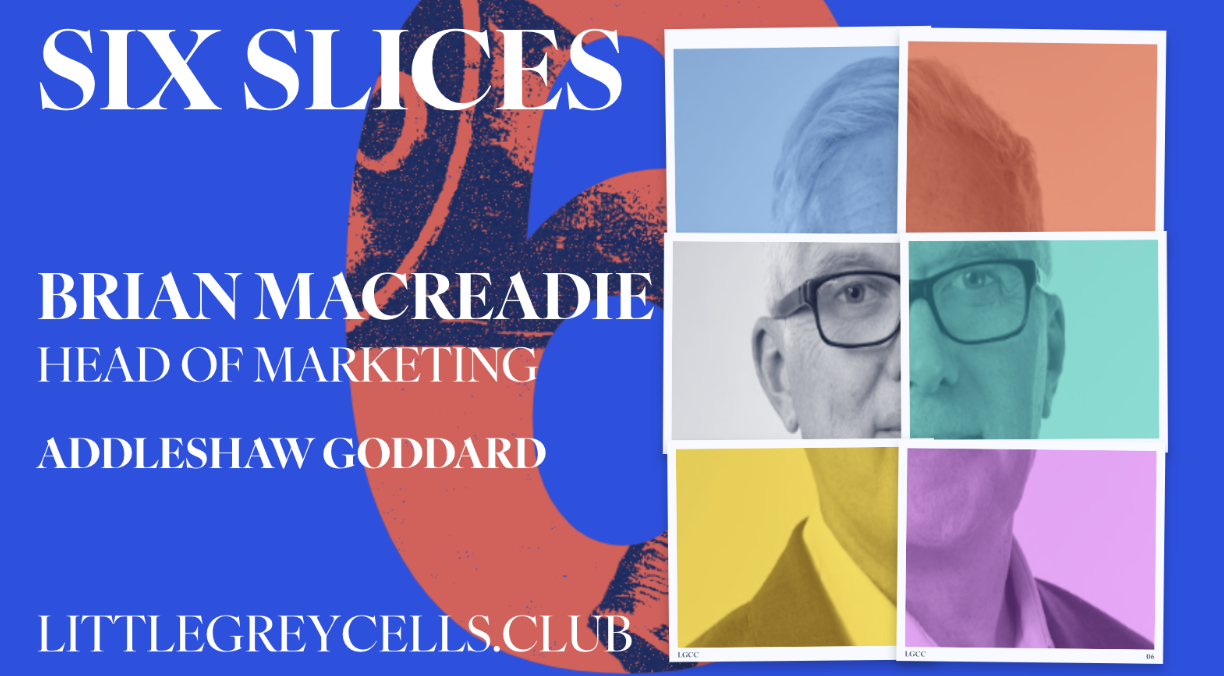
Brian Macreadie: “Without a customer, we’re nothing. So, in my world of B2B, and I suspect in B2C too, staying close to clients is the foundation of success.”
What myth would you like to bust about marketing?
There are so many marketing myths that need busting. The idea is that we you achieve long-term success through efficiency measures or cost saving is one. The trope that B2B marketing lacks creativity is another. (Headline: it doesn’t). But there’s one pervasive myth that needs to be vanquished, in my opinion: the notion of marketing ‘playbooks’. Setting aside for a moment Ritson’s solid advice to focus on Segmentation-Targeting-Positioning, and Diagnosis-Strategy-Tactics in that order, there are a lot of other charismatic vendors and commentators that imply marketing is easy if you use their tech or apply their approach. Sure, applying lessons from other marketers is sound practice, but let’s not kid ourselves – marketing is never, ever straightforward. We’re in a competitive race through a maze where the walls keep moving, and so achieving success is never guaranteed or easy. And because each of our respective businesses, categories, economic realities and the like are SO different, there can be no single marketing playbook that works for every business situation. Which means that anyone telling us how to ‘do’ marketing without first understanding our specific context is either trying to peddle us something or is likely just spouting BS. People selling fantasies are a marketing menace.
Other than your own - which brand do you most admire and why?
I’m totally jealous of Guinness’ distinctiveness, love what Lego does, am brand loyal to G-Shock watches, wish I owned a Harley Davidson, and privately always buy Heinz and Kellogg’s. I suspect Byron Sharp would call me a brand fanatic or something. But I’m a lifelong B2B guy so instead of focusing on those consumer brands I’m going to share some B2B love...
I admire so many B2B brands – a big shoutout to GE, System 1, and John Deere, for example. But one I turn to probably more than any other is insurance brand Hiscox. For decades they’ve innovated both in terms of marketing communications and product. They’ve been clear about their target segment (small and medium-sized companies) and bold with their media choices, such as wiring a digital billboard to flash every time a small enterprise server faced a cyberattack. (It flashed constantly). And they’ve built an utterly distinctive brand image. It’s textbook good. Bravo Hiscox.
In order to lead a great team, what one thing should any aspiring leader not ignore?
Capturing customer feedback is the obvious one. In B2B, listening to perspectives and signals from clients (and non-clients) should be mandatory if we want to innovate and resonate. But I hope that is so self-evident that I’m going to pick one other leadership trait that should be cherished and cultivated: permission to fail. In my opinion, unless you’re a category leader with very deep pockets, bland marketing choices and tactics get you nowhere. I want the opposite of bland ideas and ‘meh!’ marketing, which typically means trying previously untried things. Of course, we can do tests to boost our chances of new ideas succeeding, but doing untried things ultimately always leads to the possibility of uncertain outcomes. Some tactics will blossom, but some will wither on the vine. Some will fail. And I think that one of the traits of great companies and great teams is that they learn from failures and fix forward, rather than vilifying people for trying. I think it is incumbent on leaders to create that culture, and back their people.
 Applying the mantra ‘zig when others zag,’ Addleshaw Goddard’s advertising is unlike any other law firms. This example is from the firm’s RHS Chelsea Flower Show sponsorship activation.
Where does your best thinking happen - and why?
I know when it doesn’t happen… When I’m exhausted or when I’m multi-tasking 48 different things on deadlines, with hundreds of inputs bombarding my inbox, calendar and feeds. So, finding some mental space is pretty key.
I’ve also read the research from experts in the field of idea creation that our subconscious needs time to cogitate over problems, and that’s certainly been my experience. I subscribe to the view that it’s best to feed our minds with as much diverse input as possible, and then to step away from whatever problem I’m trying to solve for a few days. And then new ideas somehow emerge when I least expect it, maybe walking through a London tube station, because our subconscious has somehow been working the problem in the background. I know that can sound like mystical, psychological mumbo jumbo to people outside our profession, but I’ve heard some of the most gifted creative people profess the same thing. It seems to be how our brains are wired. (But if you wanted a more specific answer, visiting art galleries, watching documentaries, listening to podcasts on topics I’m unfamiliar with, reading about history, and reading marketing case studies from outside of my industry, are all go-to sources of stimulation for me. Lateral inputs like those are great for sparking ideas and providing a platform for new thinking.)
In marketing, what have you changed your mind about?
Honestly, I was admittedly late to the AI party, but I finally found my AI mojo in the last year. I’m now more hopeful than at any other time in my career that our profession is properly going to be able to unlock insights from our oceans of disconnected, unintegrated data. But beyond AI (because no one needs another marketer incessantly wanging on about AI), I’ve changed my mind about marketing being caught in a doom loop. For almost a decade I was fearful that our profession has lost its mind in a world of things like automated lead nurturing, short-term digital tactics, misplaced programmatic plays, metaverse fetishism, and excessive inbound marketing dogma, while losing sight of classic skills like brand building, price positioning and more. But I think that some core marketing skills and common sense have returned. Today I think we have finally found a better balance between new and time-proven marketing ideas; between sales and future demand. I’m full of optimism for the future of marketing.
Which marketing rule still holds, no matter what?
There are two for me. First, the customer is, was, and always will be king. Without a customer, we’re nothing. So, in my world of B2B, and I suspect in B2C too, staying close to clients is the foundation of success. Second – and it’s not my line, but it is the line – if you’re not the market leader, zig when others zag. The mantra is timeless, in my opinion. I prefer my chances of standing out from the crowd if I look different or act different from the crowd. Which I know is obvious, but we’ve all seen brands that don’t apply it.
Winner of Marketing Week’s Marketing Team of the Year; twice-winner of both the Grand Prix and the Creative Gold at the B2B Marketing Awards; and named the Most Creative Individual Working in B2B Marketing, Brian Macreadie is the Head of Marketing at international law firm, Addleshaw Goddard. His 30-year career in B2B marketing spans media, telecoms, and professional services industries. And to build brands and drive sales, his campaign work has ranged from sponsoring the RHS Chelsea Flower Show to launching a computer game set in a taxi, and even haunting hundreds of the world’s most senior lawyers.
Tim Healey listens, learns, and synthesises real-world best practices from hundreds of marketing professionals and presents them in these weekly interviews for MAD//Fest. Tim’s Little Grey Cells Club is a trusted, no-sales, peer-driven network where senior-level marketing directors unite to confront challenges, and drive leadership forward.


