
The AI apocalypse will be personalised
21 September 2026
AI is transforming advertising at speed. But as machines optimise the journey, keeping the human touch matters more than ever, writes MAD//Fest's SVP Global Partnerships, Ben Phillips.
Depending on which tech leader you listened to this week, artificial intelligence is either about to liberate humanity, replace humanity or decide that humanity was a promising beta product that never quite scaled.
Meanwhile, the advertising industry has responded to these warnings in the only way it knows how, by increasing investment, launching products and looking for somewhere to put the ads.
That isn’t necessarily a bad thing. While public discussion jumps between utopia and extinction, Adland is finding practical uses for AI across the customer journey.
In January, OpenAI began testing advertising within ChatGPT for some US users. The initial placements appear above or below answers and are clearly separated from the conversation. More recently, OpenAI announced additional advertiser tools and began testing sponsored brand agents.
This points towards something more interesting than inserting display advertising into a chatbot. A sponsored agent could answer questions, explain products and help customers make decisions. Advertising stops being something placed alongside the customer journey and becomes an active participant within it.
Google is approaching the same opportunity from the direction of search and shopping. This year it introduced personalised promotions within its AI shopping experiences, allowing retailers to present relevant discounts, bundles or delivery offers during a conversation.
Its Universal Commerce Protocol takes this further, creating the infrastructure through which AI agents, retailers and payment providers can work together. Product discovery, comparison, promotion and checkout could increasingly happen within one AI-mediated experience.
For retailers, that changes the meaning of visibility. Product information must now appeal not only to people and search engines, but also to the agents making recommendations on their behalf.
Meta, meanwhile, continues to apply AI across content creation, audience engagement and business management. One of AI’s most immediate advertising applications is its ability to turn a single creative platform into hundreds or thousands of relevant variations across products, audiences, locations and formats.
That doesn’t remove the need for ideas. If anything, it increases the value of a strong central idea. Automation can produce infinite variations, but it cannot magically make an undistinctive proposition distinctive. Agencies remain essential in defining the strategy, setting the creative rules and determining where automation should stop.
The same transition is visible within retail media. In April, Tesco announced a partnership with Adobe to expand its use of AI-powered personalisation. With Clubcard reaching more than 24 million UK households, Tesco has an extraordinary foundation of first-party customer insight from which to create more relevant content, promotions and digital experiences.
This demonstrates why retailers could become some of advertising’s most important AI businesses. They combine media, customer relationships, transaction data and increasingly sophisticated technology. Retail media is evolving from selling space around the point of purchase to intelligently shaping the journey towards it.
Taken together, these developments offer a glimpse of advertising’s optimised future.
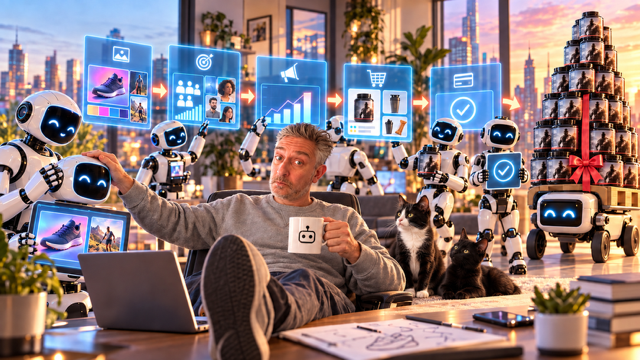
A retailer’s AI identifies a commercial opportunity and briefs an agency’s creative agent. The creative is generated, checked by another agent and supplied to an AI media buyer. That buyer locates the consumer’s shopping agent, which has already identified a previously unnoticed protein deficiency. The two agents negotiate the price, apply a personalised promotion and arrange a subscription.
The latest organically sourced pea protein powder arrives at your desk on Tuesday.
Every machine involved records an outstanding result. The only person who knew nothing about the transaction, our their immediate need for additional supplements, was the customer.
That is, of course, a ridiculous hypothetical forecast. But it illustrates the risk of treating maximum efficiency as the final objective. Advertising is not merely the movement of products, data and messages through an optimised system. It depends on emotion, imagination, humour, trust, surprise and culture, the gloriously inefficient qualities that make people human.
Which is why it was no mistake that we chose The Human Touch as the theme for this year’s MAD//Fest. As AI assumes a larger role across advertising and commerce, our most valuable contribution may be ensuring there are still humans in the process and something recognisably human in the work.


