Intuitive Signals from the AI and Innovation Stage
16 July 2026
This summer, across six articles, Livia Bernardini, chair of the AI + Innovation Stage, unpacks what marketing leaders said and what they didn’t, to help brand marketers sharpen their intuition in the age of AI.
Part One: The Median Just Moved. Did You?
Everything is converging on the same competent answer, which makes three things valuable again. Knowing what you stand for, knowing how to do so, and knowing who is worth standing with.
Chairing AI and Innovation, at a festival whose theme was The Human Touch, was huge fun, if nothing else because the tension was truly alive and surfaced on that stage. Never in my lifetime have I witnessed a change in the communication and technology landscape that sparked so many conversations across such a breadth of topics, from operations to product, to marketing and ethics.
There is far too much to cover for one piece, so this is the first of six. If you spoke on that stage and cannot find your name here, stay with me, because your wisdom will most likely surface in due course.
On a side note, let me declare my bias early, so nobody can call me out on it. Trained intuition, as the antidote to the slop, is where all of this ends up. I am aware I am predictable about it, and I am unrepentant. I put it all in writing on day one, so consider yourself warned.
With that much ground to cover, I may as well start somewhere uncomfortable.
Somewhere in your category this morning, someone with your job faced roughly your strategic problem, typed roughly your prompt into roughly your model, and got back something close to your answer.
That is the state of play, not a crisis, so I am not going to write it as one.
Everything online is now a six
Stjepan Zelić of Hypefy came on stage and had us all thoroughly entertained by asking counterintuitive questions, which anyone who knows me will recognise as my favourite kind. The one I want to share here: since we were flooded with AI-generated output, do you think creative work online has gotten better or worse?
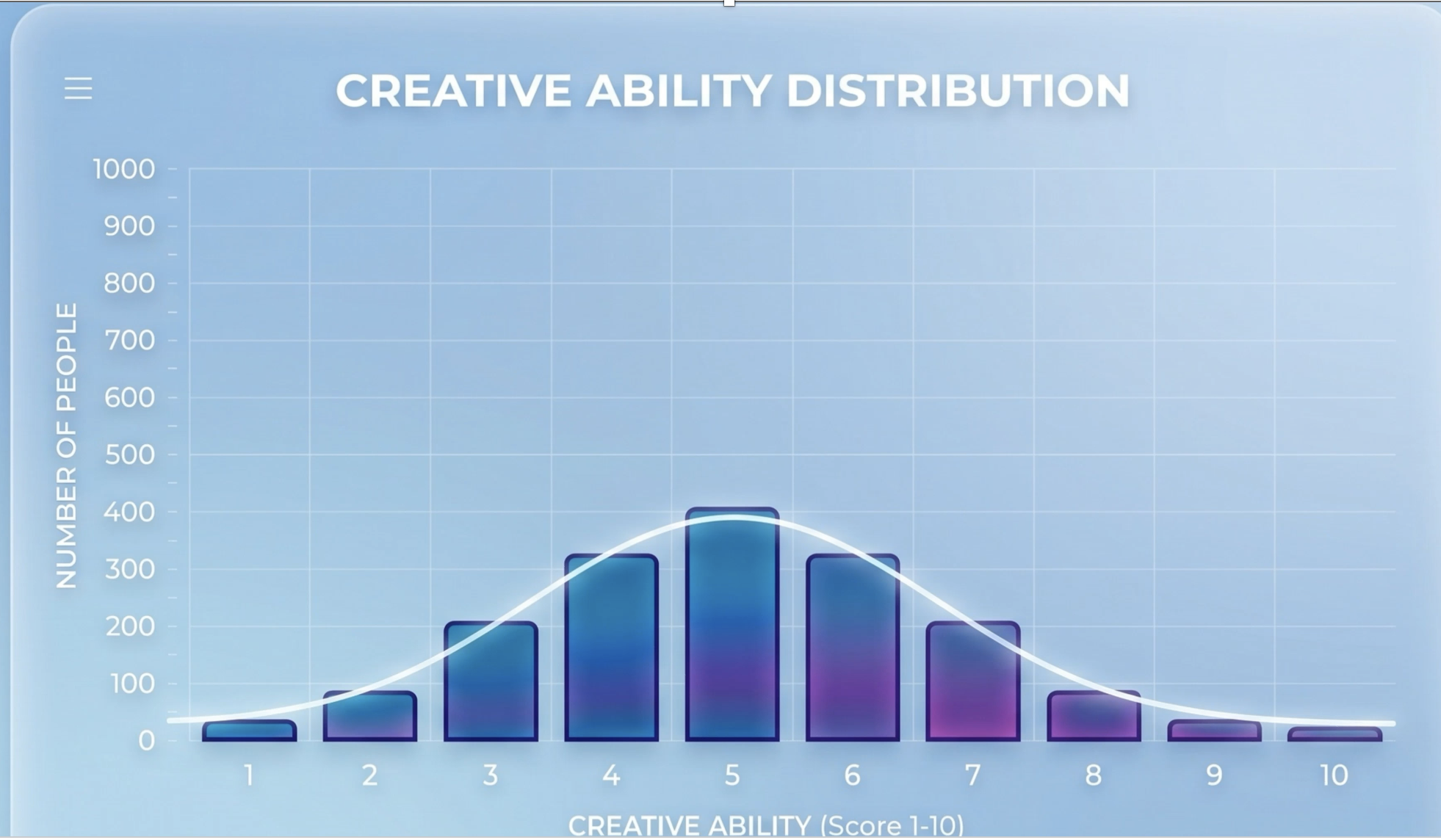
The room split. The answer, once he walked us through it, was obvious. The median human was a 5 out of 10 across creative ability. AI hauled everyone below that line up to a 6.
Before
After
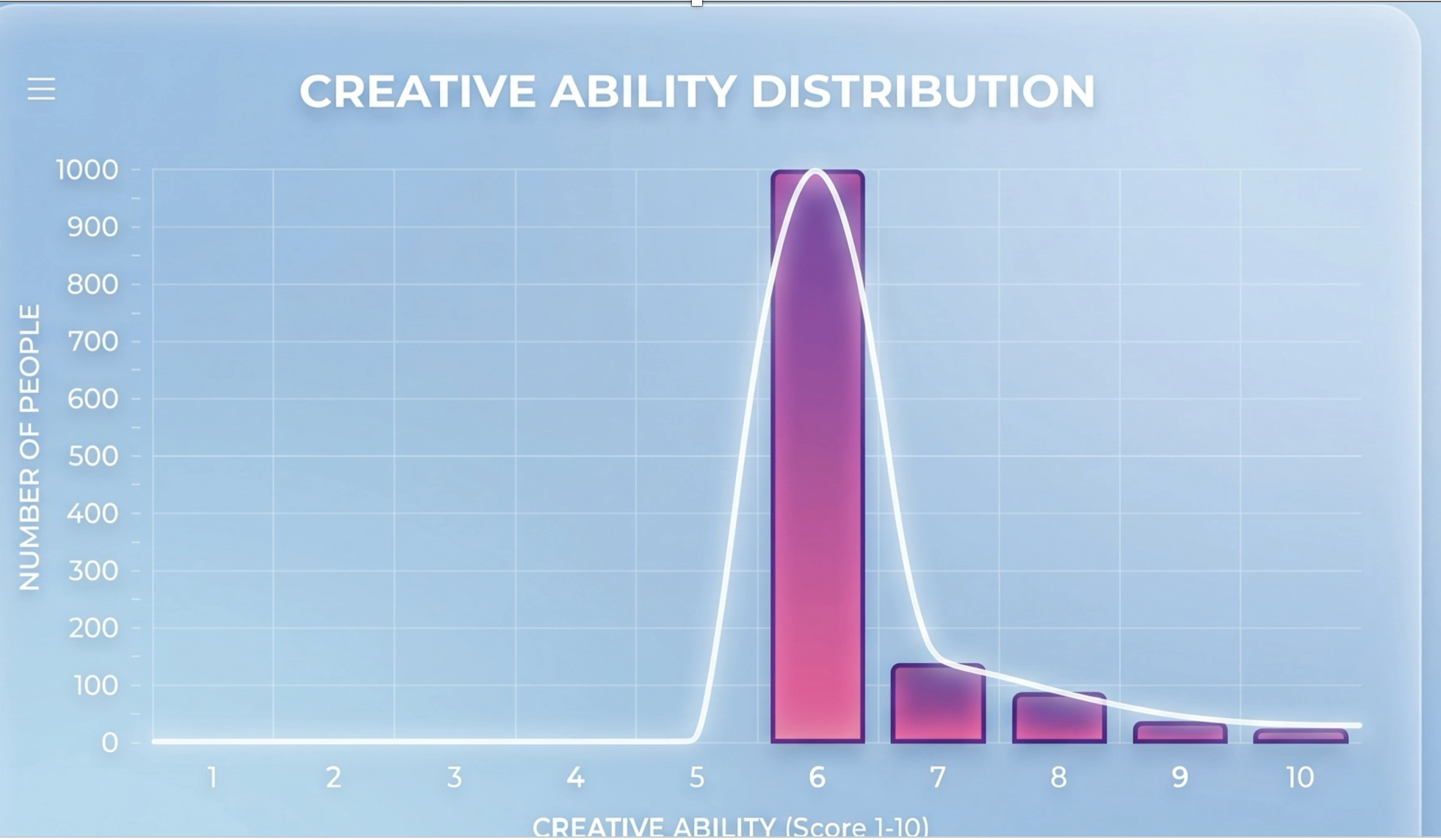
Infographic courtesy of Stjepan Zelić
From writing to image selection to design decisions, creative ability across the board.
AI removed the bad output overnight and lifted the average up to a solid 6. The people who were already above 6 stayed exactly where they were, because the machine had nothing to teach them and possibly everything to learn from.
So creative work online has gotten better. It has also become far more homogeneous. Doshi and Hauser found the same thing under laboratory conditions in Science Advances, where AI-assisted stories were judged more creative and better written, and were measurably more similar to one another than the human-only ones. Everybody meets at 6. B O R I N G. As two brilliant Maxe’s Kane and Ortington remind us, we need human mess and a bit of disco lights to be truly entertained.
But here is the best part of the paradox. Graphite now puts primarily AI-generated articles at roughly half of everything newly published in English, and the machines appear not to enjoy reading their own work. Around 82% of what ChatGPT and Perplexity actually cite is human-written.[LINK] (https://graphite.io/five-percent/ai-now-writes-as-many-online-articles-as-humans-do)
Distinctiveness has stopped being purely a matter of taste and is now also a matter of retrievability.
Which leaves three questions
If the median answer is now better, fast, free and homogeneous, then everything worth creating is in the space between the invisible 6 and the 10. Three things decide how far that distance runs, and each of them deserves more room than I can give it here, so each is getting a piece of its own.
What you stand for. Your judgement, which is the harder half of the job, because the machine is somewhat making it harder to decide given the volume, speed and fluency of its answers. So ask your question and expect a median answer, and then watch yourself very carefully as your flinch is your data to account for.
How you do it. Taste, which Mike Pearson of Wayfair defined beautifully on our stage when he told us to be less artificial and more intelligent. Taste is how you choose to do something and it’s often made of refusals, and I have discovered a great deal about mine this year, mostly by arguing with a machine about punctuation and losing my temper about a friend's deliberately misspelled newsletter. More on both, shortly.
Who is worth standing with. Who we chose to be associated with, use as a tool, ask for review and feedback, strike a partnership with, human or synthetic will shape your next phase. Keeping both groups in your curated circle is more crucial than ever.
What is coming
Six pieces, and there is a great deal still to get to. Alec Barr of OLIVER on what we quietly hand over when we let the machine do our thinking. Christina Habib of Unilever and Martin Karaffa of The Culture Factor on why your creative will not work, human or AI, if you have forgotten that culture is not universal. Ishaan Kaul of Reckitt on the unglamorous truth that adoption, rather than the tool, is the hard eighty per cent. Sara Denby of Oxford on agents that will happily go shopping on your customer's behalf and judge you on your record while they are at it. And a great many war stories, which are always the most useful twenty minutes in any room.
The median moved this year, and it will move again. The only question that matters is which direction you choose to move next.


