

How sh*t is your data driven marketing
I’m sure many of you feel like you’re behind the curve when it comes to your data-driven marketing - but are you really?
MAD//Fest is here to help you find out. We've teamed up with our friends at imagino to compile an honest view of where the industry at large is on data-driven marketing so that you can benchmark where you sit against your peers.
Want to know how your experience stacks up against other marketers, and crucially what to do to make your data-driven marketing less sh*t? Read on!

Data is the lifeblood of marketing. Back in Don Draper’s day, marketers may have trusted instinct and intuition but now, with a wealth of data to test our assumptions, delve into our customer’s behaviour, and gain certainty on what is going to work, marketing without data is like driving blind.
A vast pool of data is just a starting point. Luckily for modern day marketers, a variety of tools and martech exists to help them make the most out of that data - and these tools are becoming ever more sophisticated and are delivering greater ROI for brands.
However, these tools require careful selection, integration and implementation. Along with senior stakeholder buy-in and financial investment, this is something that many marketers believe they are not given enough of.
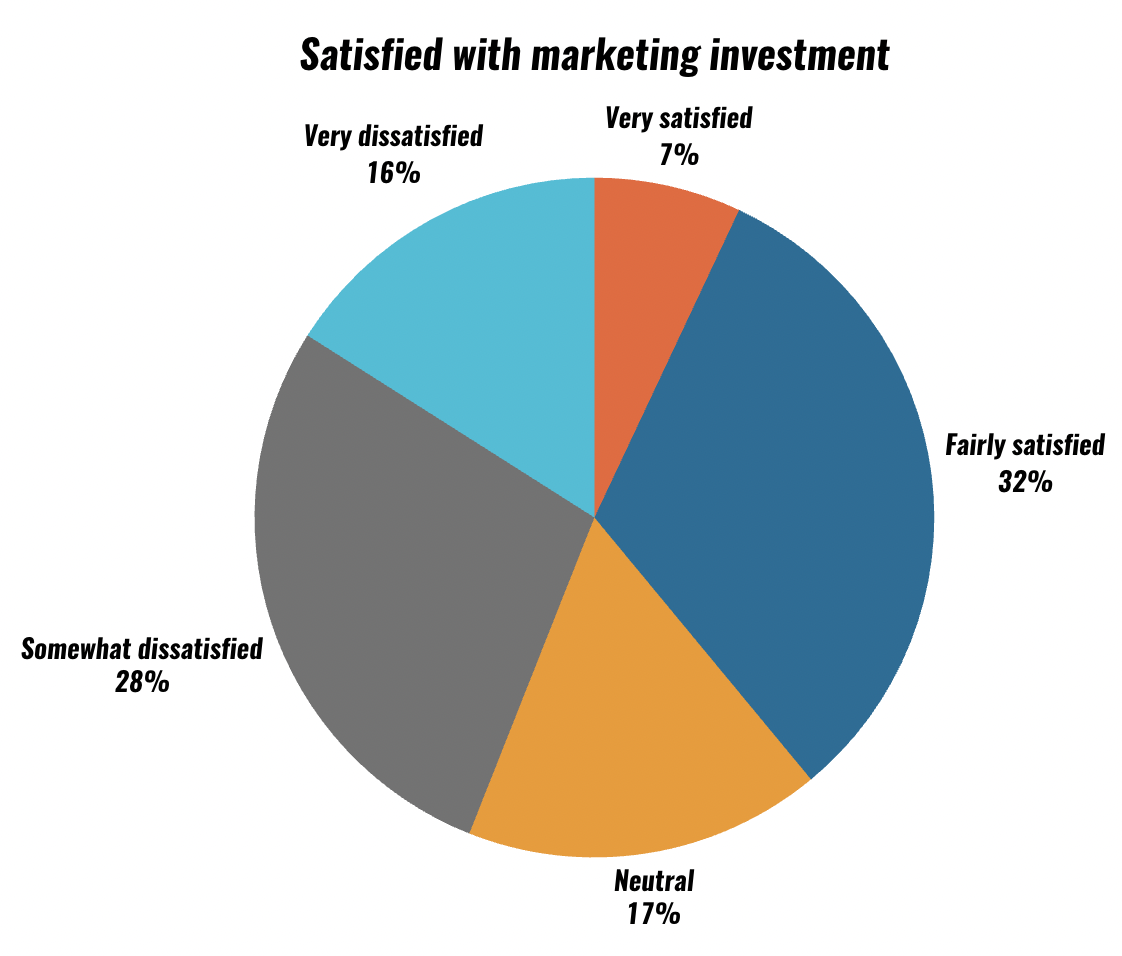
According to the results of our survey of more than 100 marketing leaders, 44% of respondents were dissatisfied with the level of investment into their department, with 16% very dissatisfied.
 This backs up an industry-wide trend that has seen marketing budgets fall for the first time in four years according to the latest IPA Bellwether report for the first quarter of 2025.
A net balance of 4.8% of firms actually cut their marketing budgets over the quarter as anecdotal evidence suggested that declining sales and reduced revenue led to a reallocation of marketing spend.
Despite history showing that the businesses that continue to invest in marketing when the economy is depressed tend to thrive, many are still opting to cut marketing expenditure, making the investment case for much needed tools and systems to enhance data-driven marketing a hard one to make for some.
The CMO of one high street retailer says: “It’s a tough environment out there, customer spending is down. It’s a difficult time to be asking for large investments, regardless of how much it is needed. Every cost line is being scrutinised right now.”
However, there is evidence that a bigger issue may be at play and the needs of the marketing team are often overlooked.
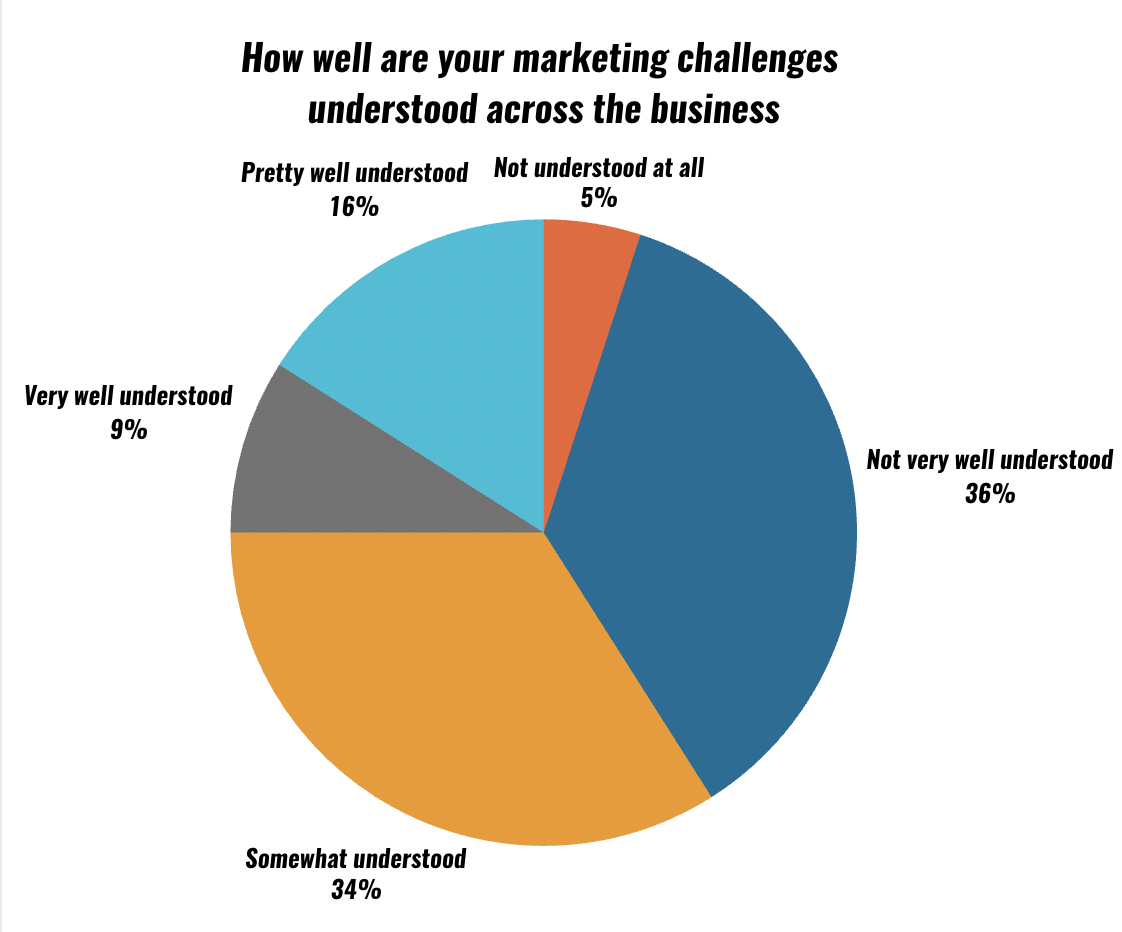
Our survey found that only a quarter of marketers feel their challenges are well understood across the business, despite 61% saying they communicate them regularly.
 McKinsey’s recent report, The CMO’s comeback: Aligning the C-suite to drive customer-centric growth report, published in June 2025, flagged this disconnect and found a widening gap between what a CEO thinks and what a CMO thinks.
The report, written on the back of the consultancy’s CMO Growth Research Survey, highlighted an “alarming” 20 percentage point drop over the past two years from 90% to 70% in the number of CEOs that say marketing has a clearly defined role within their organisation that is well understood across the C-suite.
This fall comes as responsibilities have become more fragmented with marketing, sales and digital departments all focused on acquiring customers and driving growth.
The same study found that while almost two thirds (64%) of CEOs say they “feel comfortable with modern marketing”, less than a third (31%) of CMOs feel their CEOs are actually comfortable with modern marketing.
The marketing ecosystem has undoubtedly become more complex due to increased channel fragmentation, technological advancements and evolving consumer expectations.
For some marketers we spoke to, the message simply isn’t getting through to business leaders.
The digital director of a publishing business said: “Despite regularly speaking to our managing director about the limitations of our digital marketing, we don’t get the investment needed - instead, it seems to go to sales teams.”
The long-standing view of marketing as a cost centre, rather than a growth centre still prevails, according to the CMO of the high street retailer.
However, the senior marketing manager of one FMCG food brand who is satisfied with the level of investment in their team, says securing that budget has been down to building a strong investment case that illustrates the impact on core business metrics such as sales and profits.
Where have investments been made?
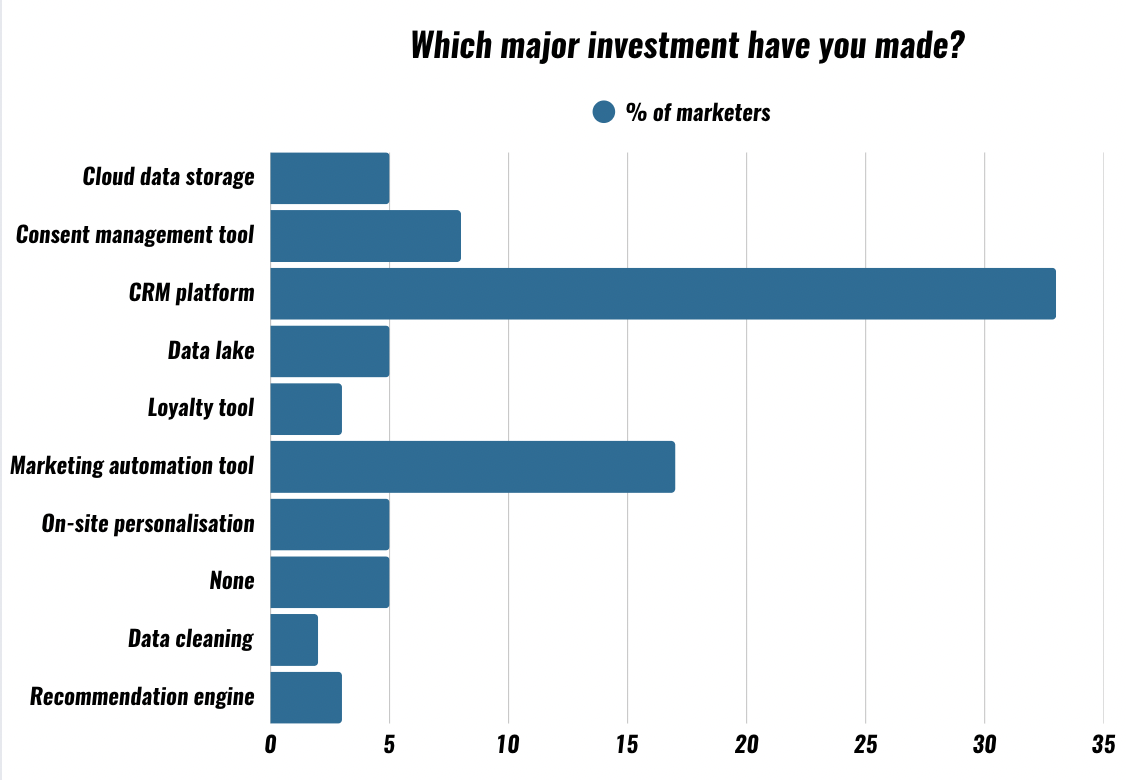
Despite the dissatisfaction in investment levels in some quarters, some major investments have been made over the last three years to improve data-driven marketing capabilities.
In fact, a third of those surveyed said their company had invested in a CRM platform over that period, making this the most popular investment.
This was followed by marketing automation (17%) and customer data platforms (15%).
 But worryingly less than half of marketers (48%) surveyed believe their major investments have been value for money.
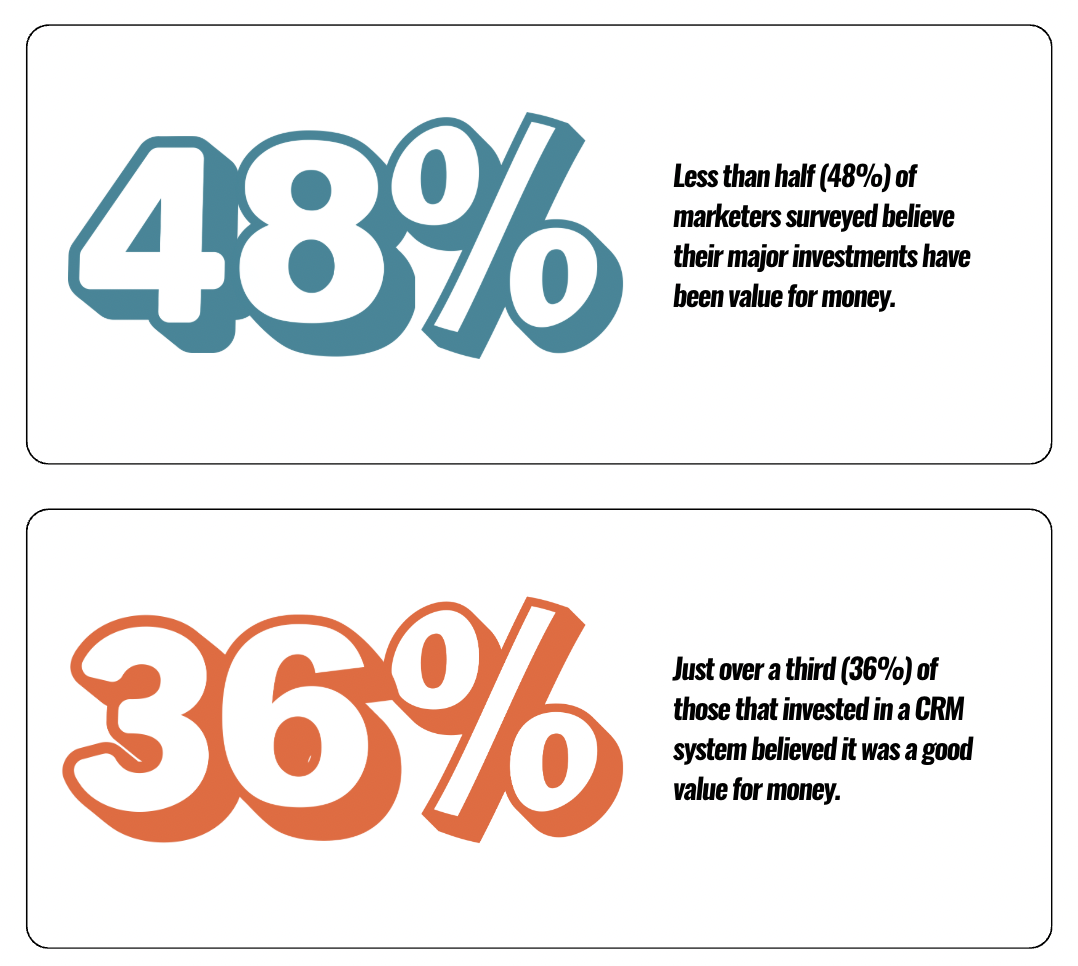 Those that invested in CRM platforms and data lakes were the least convinced. Just over a third (36%) of those that invested in CRM and 40% of those that invested in a data lake believed it was good value for money.
Such projects are often underestimated in terms of their complexity and the impact it will have across the whole organisation. It is not just a tech project, it’s also about people and all too often employees - the end users - are overlooked.
Such projects are also susceptible to delays.
In fact, more than a third (36%) of marketers have projects that have been delayed for more than a year, with major overhauls such as new CRM or customer data platforms (CDP) and website relaunches the most commonly mentioned projects.
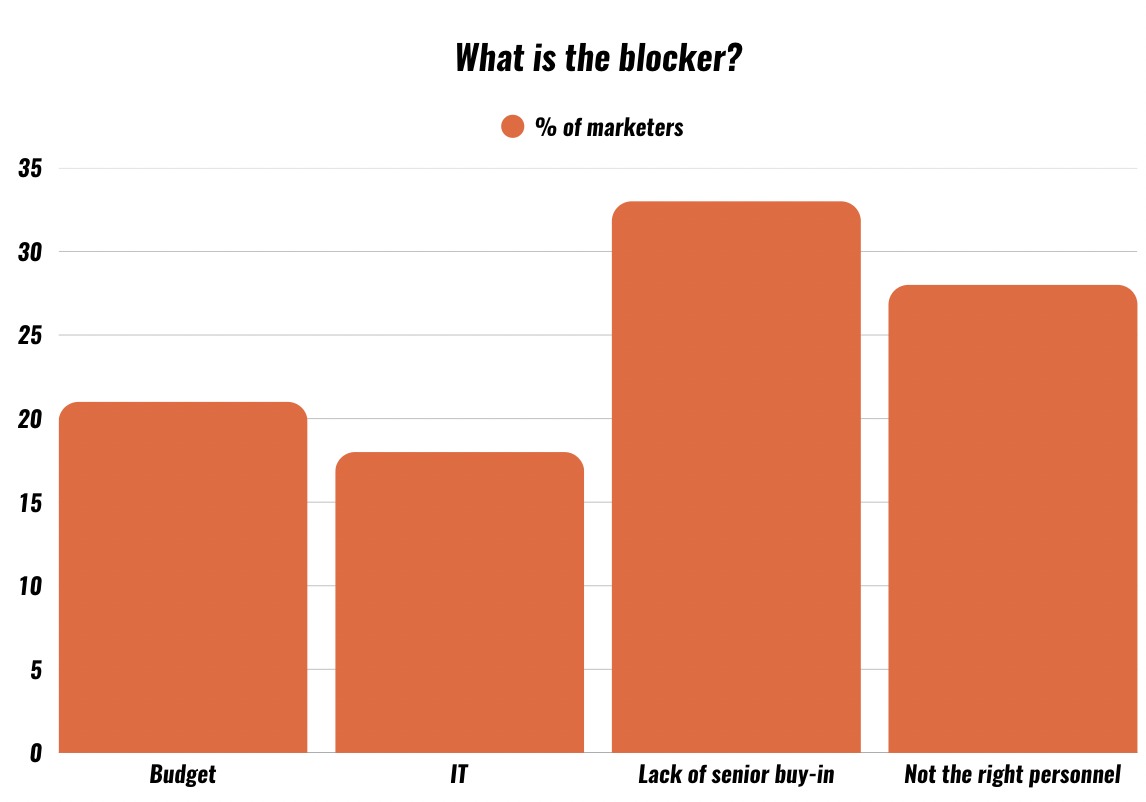
The biggest blocker to these projects are people - either a lack of senior buy-in (33%) or not having the personnel to lead the project (27%).
 Having an executive sponsor of major marketing investments, especially large-scale systems implementation, can help keep things on track. This sponsor should act as a spokesperson for the project and help gain and maintain support from not just the senior management team but from departments across the business.
They should also be the conduit to feedback any concerns about the project, and to ensure that teams across the organisation are fully briefed and trained in how to get the most out of any new tools or tech.
After all, technology that is not understood or used properly is destined to be ineffective.
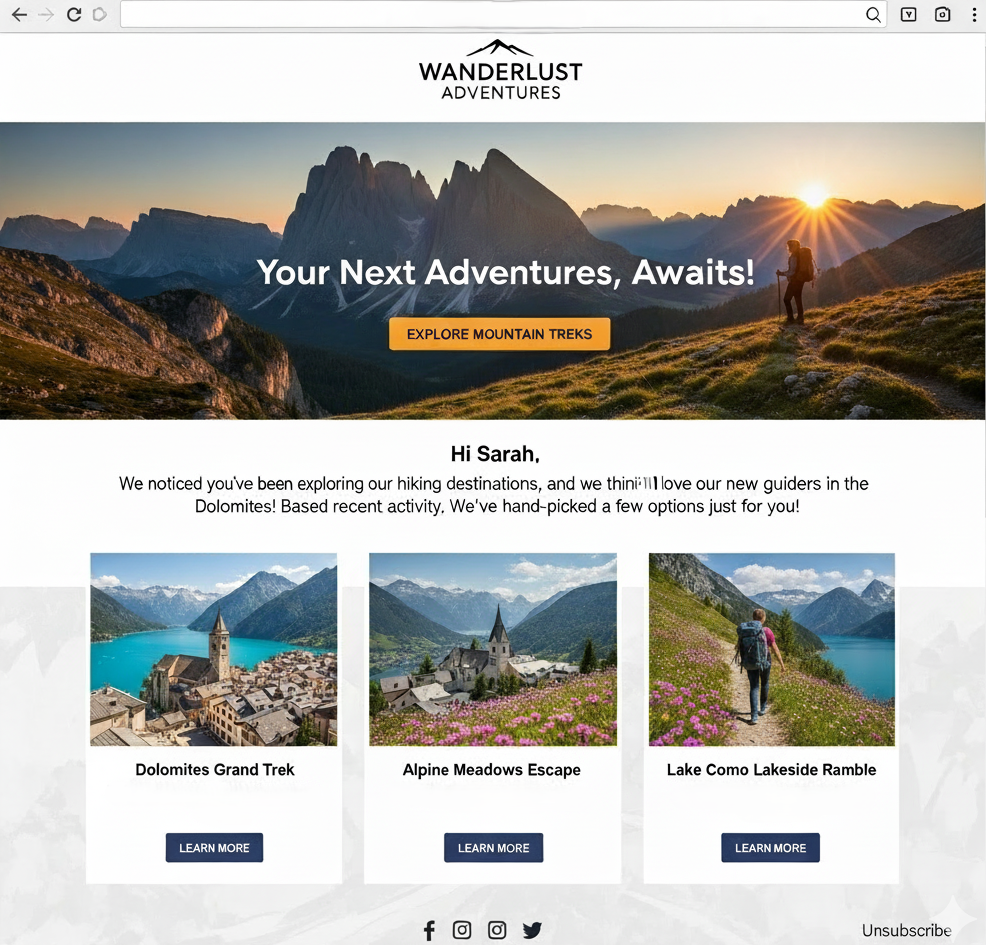
Few would disagree that personalisation is a fundamental of good marketing.
Tailoring the products, messages and experiences to individual customers has been shown to deliver strong returns - and it’s what shoppers want.
McKinsey research found that 71% of consumers demand personalised interactions and 76% get frustrated when they don’t get them.
The CRM lead of one online fashion retailer told us: “Highly targeted, product led campaigns are where we get the highest engagement and sales.”
However, the marketing industry is still not delivering sophisticated personalisation to our customers.
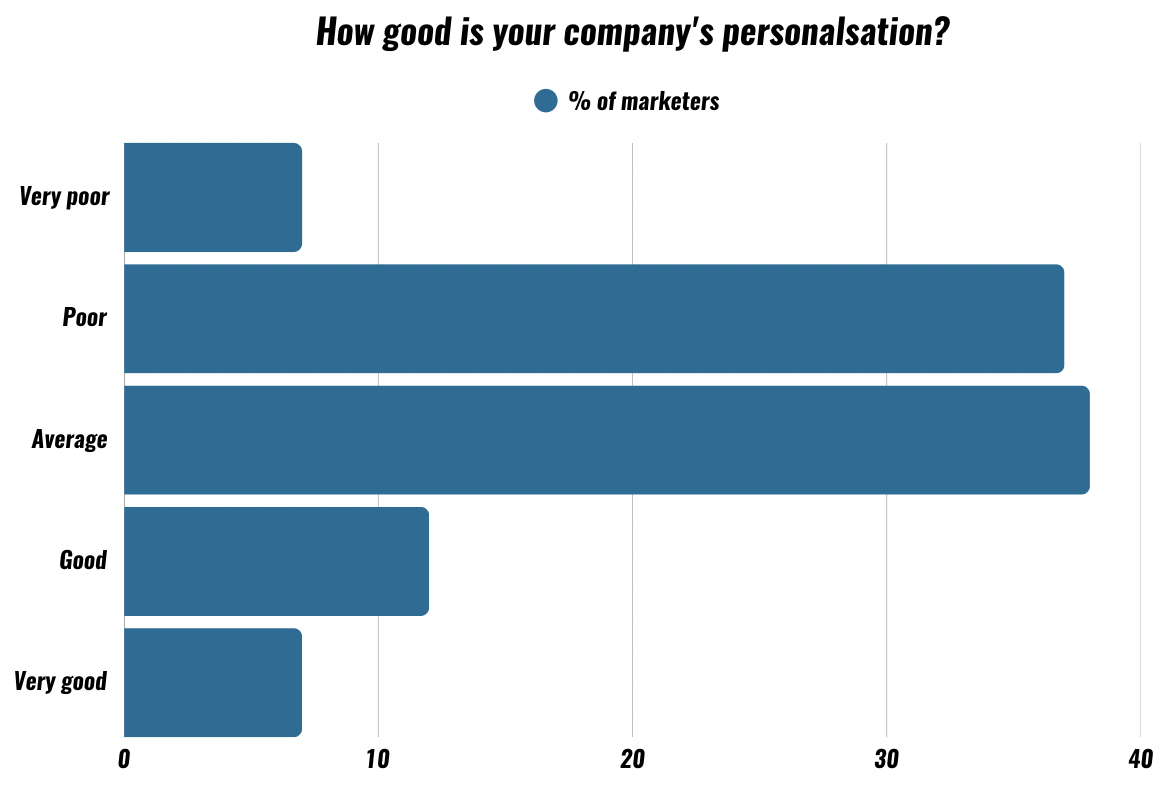
In fact, 44% of marketers say their company's personalisation is poor or very poor, compared to just 18% that say it is good or very good.
 This poor personalisation may well be having an impact on loyalty. Just a quarter of marketers say their marketing strategy encourages either lots (10%) or quite a lot (15%) of loyalty.
So what is holding marketers back?
Channel proliferation seems to be an issue, with 42% of marketers saying they do not offer a consistent experience across channels.
Hearteningly, customer segmentation is commonplace with only 14% saying they do not segment and instead still rely on sending full blast emails to their database.
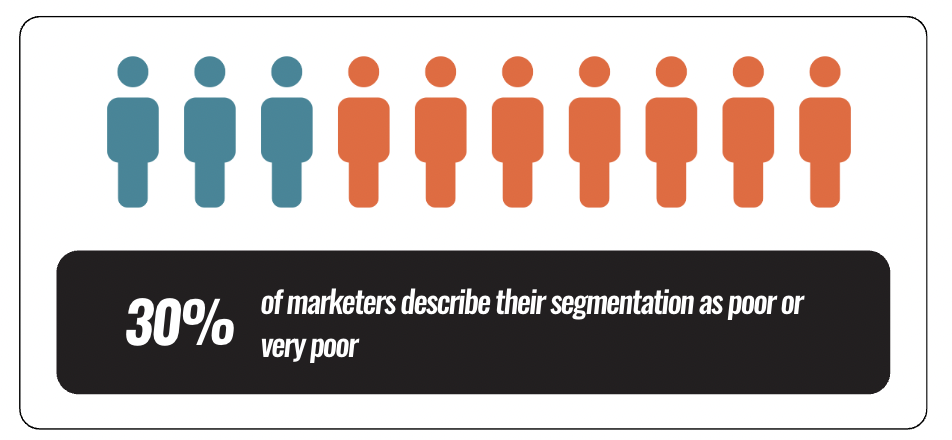
However, we should spare a thought for the quarter of marketers surveyed who described their segmentation sophistication as poor, with an additional 5% describing it as very poor. This isn’t what any marketer wants, and can point to poor data integration, analysis and execution, or a lack of clarity on what a sophisticated segmentation would look like for your business.
Conversely, 9% believe their segmentation is very good - and a further 23% say their company does a good job in this area.
 The majority of companies do A/B testing of email marketing, with just over a quarter of marketers (27%) acknowledging they don’t split test their emails.
With a wealth of AI and automation tools available, why are so many marketers seemingly only still serving a very basic version of personalisation?
Budget and knowledge appear to be the most common reasons.
“We’ve done a fairly basic job at personalisation - segmentation, adding customer names into subject lines - but it’s all very rudimental. I’d like to do more but we don’t have the budget, tech or knowledge to do this - and there’s zero desire from above to put some real money and resource into it,” says the digital director of the publishing business.
For others, data and how it is stored and accessed is the big barrier to more sophisticated one-to-one personalisation.
One marketing boss said: “Our data is not unified. It’s scattered across lots of departments and it’s not in a good enough place to implement one-to-one personalisation. We’d need our systems to talk to each other in near real-time and we’re light years away from that being a reality.”
It is a similar story for the publishing industry digital director. “Our data is not good enough for personalisation at scale, particularly third-party data.”
Disparate data and unintegrated tech is holding back brands and, as we delved into in the previous chapter, budget limitations are preventing many marketers from investing in technology such as customer data platforms that can solve these issues.
Personalised product recommendations
 Personalised product recommendations is a big area of focus for many marketers and just over half (51%) of those surveyed said they served tailored suggestions to their customers.
There are of course different levels of sophistication when it comes to recommending products.
The most advanced use recommendation engines, which utilises machine learning and AI to generate product suggestions and predictive offers tailored to each customer based on information such as browsing and purchase history.
This has proven highly effective. According to McKinsey analysis, 35% of what consumers bought on Amazon came from its recommendation engine.
As AI develops, many other businesses are investing to improve their own product recommendations.
The Very Group, a business that has invested heavily in personalisation in recent years, introduced new AI search, browse and autosuggest tools across its website and app last year.
Using AI natural language processing, machine learning and data, these tools learn from anonymous individual interactions and collaborative behaviours to optimise the product discovery experience and provide Very customers with faster, more personalised results.
The rise of AI means we are now entering a new era of personalisation. However, the gulf is set to widen between those that invest in the right tech and tools to serve customers tailored content, offers, and recommendations and those that don’t.

Automation should be a given in any marketing team. Businesses can target customers with automated messages across email, online, and social media to help boost sales and efficiency.
Nucleus Research found that marketing automation returns an average of $5.44 for every $1 spent and most companies recover the initial cost of automation software within six months.
But how good is our automation as an industry? Not very, according to the marketers surveyed.
More respondents believe their automation is poor than good - with over a third (34%) saying it was poor or very poor, compared to less than a quarter (23%) who sat in the good or very good camp.
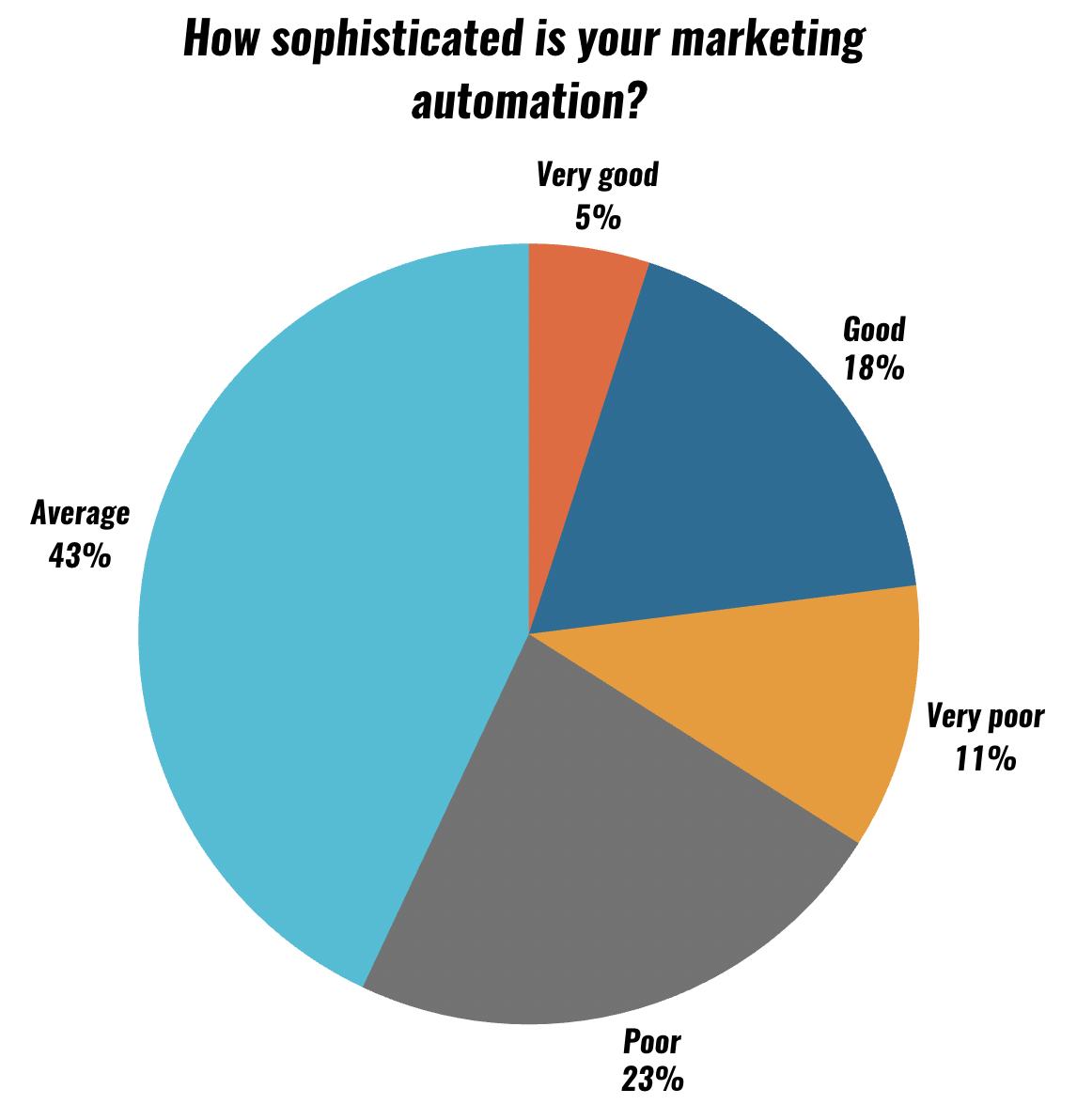 Just 30% of marketers say they have a fully automated customer journey. So what is holding marketers back?
The publishing industry digital director said: “To be honest, you’re only as good as the automation tool you use. We brought in a new vendor that we thought would be great and turbocharge our automation, and it’s been a complete let down.”
However, it’s not just about buying the right tool - it’s about the technology and data integration, with essential training, set up and long term support from the vendor essential.
Common issues include a lack of automation strategy, ineffective segmentation, and poor data hygiene which can hold back marketers.
One area where the industry has focused its automation efforts is abandon basket campaigns, particularly within retail, with just over half of retail marketers surveyed running such emails.
It’s no surprise that marketers have focused on this area. According to analysis from Klaviyo, cart abandonment emails generate more engagement and revenue than any other type of email.
Abandoned cart workflows also drove the highest conversion rate at 3.33%, according to the research.
Speed and data access
A benefit of marketing automation is of course speed, with many email campaigns triggered automatically. Speed is an area where many marketers feel like improvement is needed in their organisation. In fact, almost a third (30%) of marketers are moving at a slower pace than they would like.
A big drawback here seems to be data access. Almost half of marketers admit they exclusively use spreadsheets for extracting or updating data or reporting and just over a third (36%) of marketers can self-serve all the data they need.
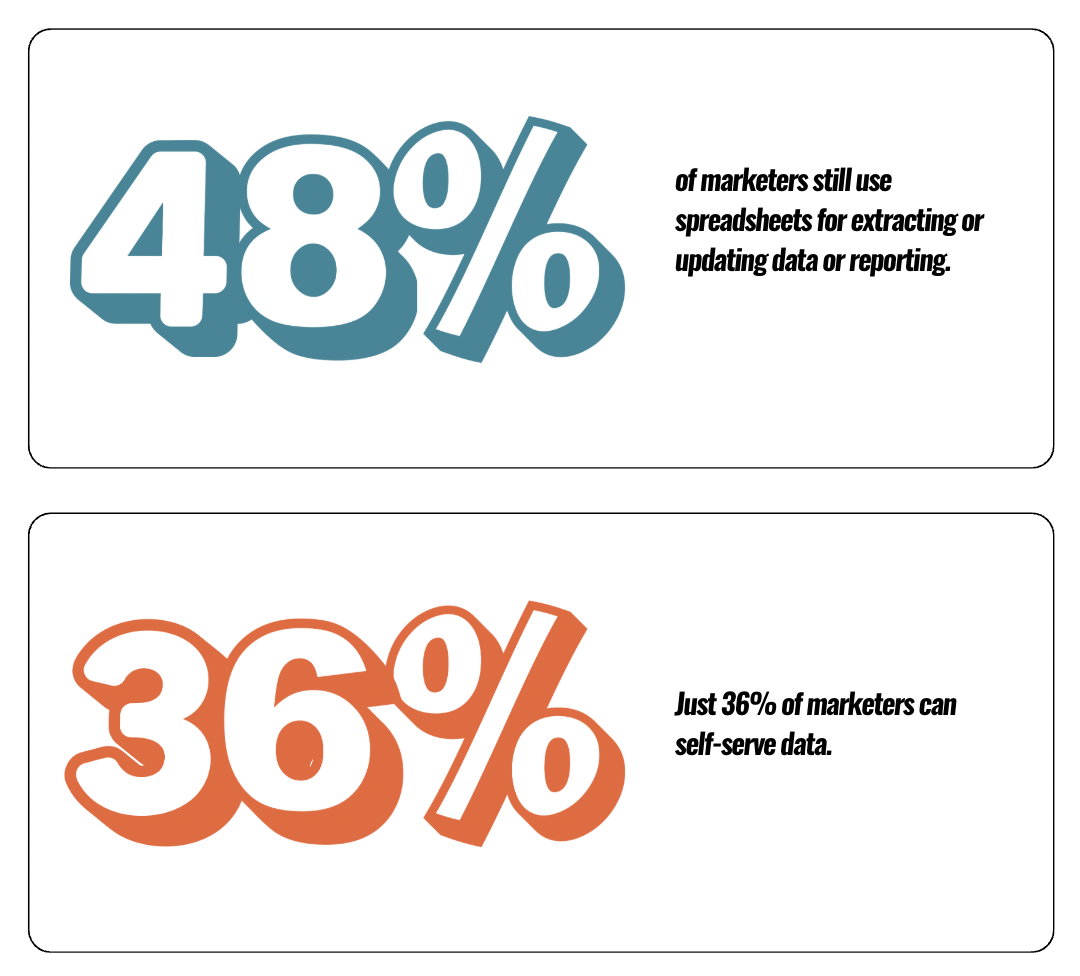 This inability to view, analyse and react to data will undoubtedly be hurting marketing teams.
One senior marketing manager said: “The data team is overwhelmed with requests and we’re waiting weeks for information that we should be able to get in minutes.
“If we can’t see our own performance or how the customer is behaving, how can we react to it?”
How are marketers using AI
AI is impossible to escape, both in everyday life and in this report. It has made its way into many workplaces and is now an essential tool for many.
In fact, more marketers say they are using AI in their marketing than not.
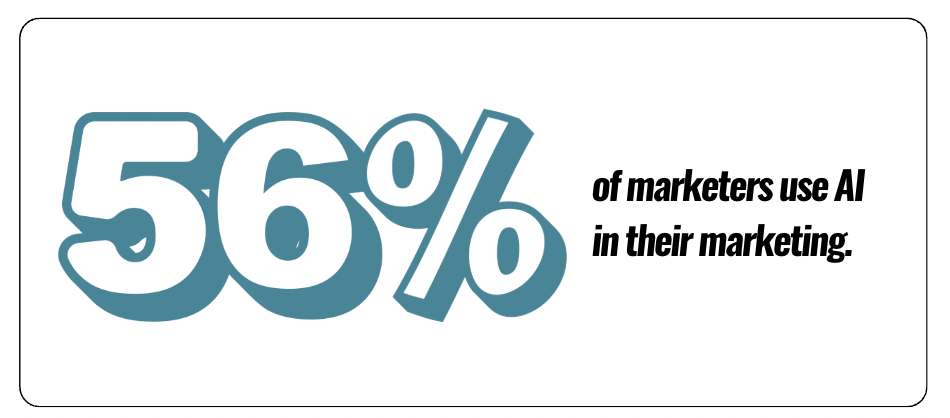 By far the most popular use of AI for marketers is in copywriting followed by creative.
However, these use cases are only scratching the surface of what AI can do to transform digital marketing.
AI technology can automate processes, analyse data, and engage with audiences. Some are already doing this with multiple respondents stating that AI is used for data analysis and forecasting in their companies.
The senior marketing manager at a food brand said: “We’re just getting started with AI. I’m sure in the next year or two it will be used widely. There’s pressure from above to use it more so we’re developing our roadmap.
This desire from management to use more AI in marketing is widespread, with more than half of the marketers surveyed saying the leaders in their businesses were eager for this.
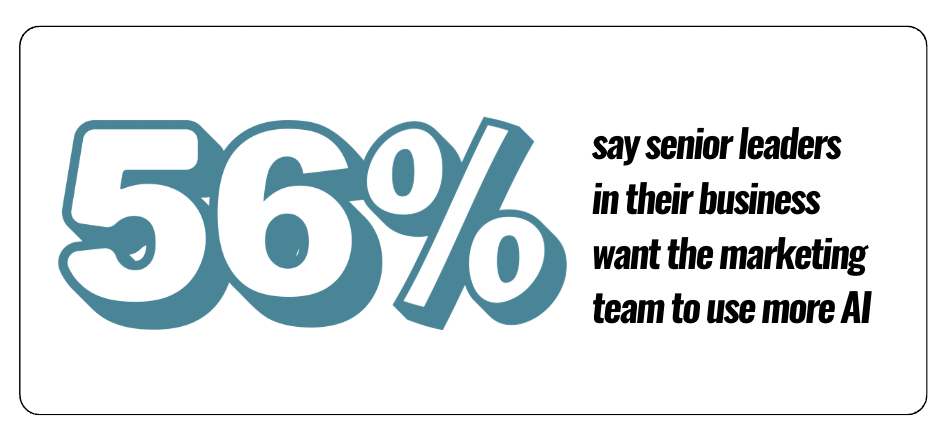 The most popular areas that company leaders want marketers to apply AI is in creative and data analysis.
However, the digital director struck a note of caution. “Usually I’d be delighted at the prospect of our MD wanting to apply more tech but he’s jumping on the AI buzzword and his sole aim is to make cost savings.
“However, even the mention of AI is opening doors and conversations with senior management right now.”
Marketers can use this excitement to their benefit. If they develop the right use cases for AI in their business, this might be the key to unlocking more investment for their team.

Understanding customers is at the heart of all marketing. No matter how emotive a creative or compelling a product, if we don’t know who our customer is and why and how they are driven to buy, our marketing efforts will fail.
However, this survey has shown that many marketers are still feeling in the dark when it comes to understanding their customers and what works.
A single customer view is still not commonplace, with 59% of marketers surveyed admitting their company does not hold this. Although the good news is that almost three quarters (73%) of those that do have a single customer view trust it.
Meanwhile, just over half (52%) of marketers analyse the lifetime value of their customers, which helps businesses understand the long-time financial worth of individuals.
Marketers with little information on who their most profitable - or indeed unprofitable - customers are can give little focus on retaining their most lucrative shoppers or clients.
To add to this, just over a third (35%) of marketers are confident they have recency, frequency, monetary value (RFM) data on their customers and lifetime value is still not commonplace with just over half (52%) saying they hold this.
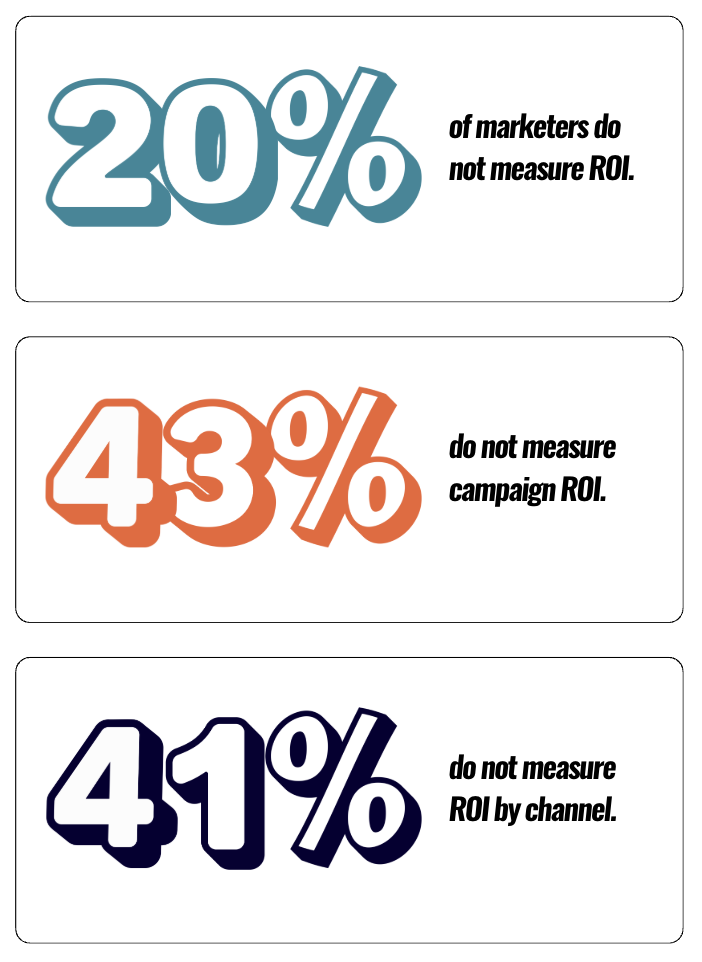
There are also big gaps in measuring the effectiveness of marketing. Hearteningly four out of five of those surveyed said they measured ROI, with more than half breaking this down for each campaign and channel.
 Just half of the marketers surveyed use attribution modelling, which analyses and assigns which touchpoints in a customer’s journey to purchase led to a conversion. This helps marketers determine what touchpoint or campaign was effective.
This information can help marketers make smart, data-driven decisions about where to spend their marketing budget in near real time, ensuring that spend is not wasted.
Attribution modelling can also help marketing teams work out how to target their campaigns to reach more high-converting customers.
However, according to WARC’s The Future of Measurement report just 2% of marketers are using attribution, experiments and marketing mix modelling (MMM) - which measures the performance of different marketing channels using aggregated data - together.
The retail CMO said: “We measure what we can. It’s crucial in a retail business but it’s getting more complex and I’m not sure we have the bandwidth in my team to incorporate more data sources into our analysis and measurement.”
The good news is that WARC predicts the next 12 months will be defined by a “democratisation” of tools and methods.
WARC managing editor Paul Stringer predicts: “MMM and experiments - once considered the preserve of more advanced advertisers - are now more accessible.
A growing portion of advertising are beginning to embrace these techniques to measure the effects of advertising over the short and long term.”
The same can be said of analytics, with retailers themselves playing a role in boosting customer understanding across the industry thanks to the rise of retail media.
The world’s largest retailer Walmart has gone a step further in the creation of its Scintilla division, which aims to monetise its deep customer data and insights.
Scintilla allows suppliers and brands to delve into data such as shopping patterns, sales performance, and customer perception surveys and its Insights Activation tool integrates with Walmart’s retail media network to identify media strategies.
This proliferation of new tools and methods provides a unique opportunity for smaller brands. Smart marketers will embrace the wealth of new tools on the market to help bring their own understanding of the customer in line with leaders like Walmart.

Our survey has highlighted that many marketers feel are not where they should be when it comes to data-driven marketing. But what can they do to improve this? Imagino VP of marketing Laura McHenry gives her top tips.
Data is not sexy, but it enables sexiness.
A simple, but rarely asked, question. Do you have the data you need to be effective as a marketer? And I’d add to that, do you have the data you need to prove your effectiveness?
We see a large number of marketers unable to calculate ROI by campaign and channel, unable to calculate the lifetime value of their customers. Taking a moment to understand what’s missing, although it may well feel like opening a can of worms, is essential.
Two phrases guaranteed to make the C-Suite happy:
1. “ROI on this channel delivering significantly better than that channel.”
2. “Lifetime value has increased by x% since we launched our re-engagement campaign.”
Suggestion #1 - Work out what you don’t know
Stop living in the past
Once you’re happy that all your data points are tied in - it’s important to look at how they’re integrated into your CDP or single customer view provider.
The majority of our respondents said that their customer data took more than 24 hours to update, with huge variances across different channels. As marketers we don’t need to spell out how far from ideal this is. Targeting and segmenting accurately is practically impossible when the data is not updated in the moment.
We’re also not confident that we’re including those often forgotten but incredibly important channels like customer service, chatbots etc. If a customer has launched a tirade about a missing order this is probably not the time to try and upsell them the matching handbag.
It explains why 58% of our respondents either felt they didn’t have a single customer view, or didn’t trust that what they had was accurate.
From a technical perspective there is no reason why the customer record should not be updated in close to real-time.
Suggestion #2 - Get real-time customer data updates from your tech vendors. Or find new tech vendors.
Even shiny new things need a purpose.
The responses around the adoption and future of AI within brands accurately reflected the conversations we’re having in the marketplace.
Everyone agrees it sounds like a good idea. Indeed the C-Suite are all for it (one respondent said their company had an ‘AI Everywhere’ initiative). But no one seems totally sure where they’ll see the most benefit and are looking to vendors to guide the discussion and tell brands what is possible.
At this early stage this can lead to a real Ouroboros situation with tech vendors making a ‘best guess’ at where AI could be useful, and marketers not knowing enough about AI capabilities to drive the roadmap discussion to their own goals.
Suggestion #3 - Don’t just focus on ‘available now’ use cases for AI.
Ask for a workshop with your tech vendor to drive their AI roadmap. You know better than them what ‘success’ looks like