
How China Is Rewriting the Rules of Marketing
18 May 2026
From high-speed rail to hyper-competitive EV markets, China has become the world’s fastest laboratory for consumer change, forcing marketers to rethink speed, innovation and organisational responsiveness, writes Ian Maskell, Founder, P E C O R I N O, and former VP Global Marketing, Unilever.
I spent three weeks travelling through China in April. Part holiday, part reality check.
I lived in China for 15 years between 1996 and 2009, working for Mars, Inc. and Unilever working across iconic brands from Snickers and M&M’s to Magnum and Ben & Jerry’s. Back then, China was chaotic, dirty, exhilarating and frequently exhausting. Infrastructure was inconsistent.
In February 2004, while studying Chinese, I spent a month travelling by train across the country. Kunming, Chongqing, Chengdu, Pingyao, Xi’an & more. Smoke filled hard sleepers, dirty chaotic stations and a permanent sense of improvisation at impossible scale. Domestic travel was an endurance sport. The defining book of that era ‘Mr China’ by Tim Clissold, perfectly captures the beautiful madness of that period.
This trip in 2026 felt like visiting a different civilisation.
Starting in Shanghai, we travelled to Wuyuan in Jiangxi province, staying in a boutique hotel in the village of Hongguan that would not have looked out of place in Copenhagen or Kyoto. Beautiful architecture. Immaculate service. Sophisticated design. The clientele were affluent Shanghai professionals escaping the city for a rural break.
We then cycled for three days between Jiangxi and Anhui through tea plantations connected by perfectly maintained roads. Everything clean, organised & quiet. Electric vehicles everywhere.
In Shanghai, more than 60% of new cars carry green EV licence plates, it feels like that number on the road too. More than 130 EV brands are competing in a brutal Darwinian battle for survival. The roads are smooth, the metro system is vast and frictionless, the city feels startlingly calm for such a huge metropolis.
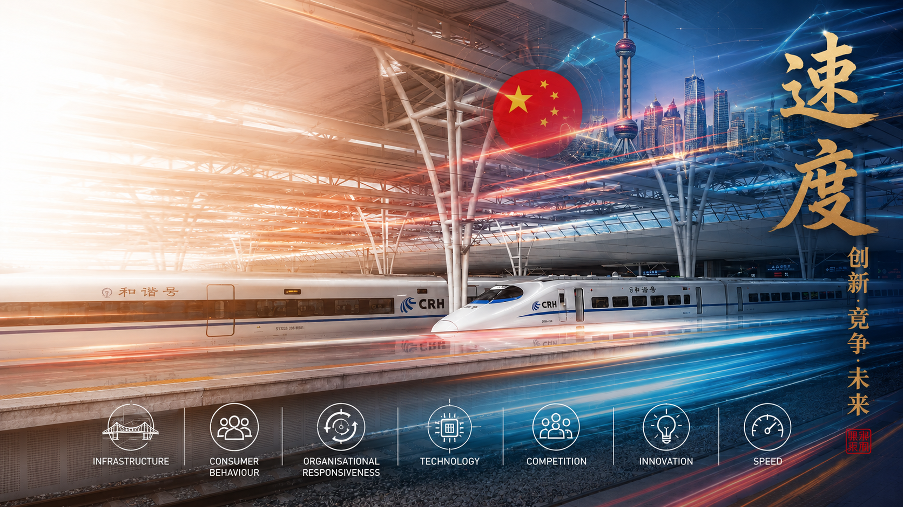
The Gaotie (高铁) is China’s high-speed rail system. A 45,000km network, built since 2008, runs more than 4,500 trains at speeds up to 350km/h, with departures every 5 to 15 minutes on major routes.
We travelled from Shanghai to Hong Kong in eight hours. Then Chongqing, Chengdu, Xi’an and back to Shanghai. Every train departed exactly on time. Every station was spotless. Shanghai Hongqiao station feels like a high-tech international airport. Compared to the decaying grandeur of many European train stations - the contrast is stark.
Chongqing (maybe the largest city in the world?), once gritty and overwhelming, feels like a futuristic mega-city operating with astonishing efficiency despite its (upto) 30 million population. Chengdu is equally modern and clean with extraordinay history. San Xing Dui civilisation existed at the same time as Tutankhamun, the 3,000 year old relics are housed in an architecturally spectacular museum opened in 2023. In Xi’an, the Terracotta Warriors are housed in an equally impressive museum complex worthy of global acclaim.
The pattern becomes clear. China is executing long-term strategic planning with relentless discipline at extraordinary scale. Seamless technology integration. Univrsal Wechat/Alipay mobile payments (cash has disappeared), DiDi is way better than Uber – all providers in a single platform. Consumers adapt at breakneck speed.
The important political questions around China cannot be ignored, but from a marketer’s perspective there are lessons hiding in plain sight. China has become the world’s laboratory for competitive intensity.
The speed of innovation is ferocious. Brands iterate fast. Consumers adapt faster. Infrastructure scales. Weak players disappear. Entire categories appear & evolve in months.
The West behaves as though the future will arrive gradually. It won’t.
The rise of China is a story about execution & ambition. What happens when a nation decides to build at scale over decades without losing momentum. Marketers should pay attention.
China’s real advantage is not lower costs or better technology. It’s the extraordinary speed at which competition, infrastructure and consumer behaviour evolve together, forcing brands to adapt in real time or disappear. The lesson for marketers is profound: in the next decade, organisational responsiveness may become a greater competitive advantage than brand size, legacy or even creativity.
China no longer evolves at the pace Western organisations are designed to handle, its time to move fast, take risks, be bold.