
The death of the traditional marketing funnel
9 February 2026
The neat path from awareness to purchase is broken. In a world of social commerce and infinite touchpoints, brands win by mastering the messy middle, not forcing a straight line, believes marketing expert and ex-Diageo Global Marketing Director, Annalisa Tedeschi.
Welcome to the new chaotic unpredictable customer journey, that has no beginning and no end (RIP to all funnels)
One of the most important skills modern marketers must develop is the ability to immerse themselves in real human behaviour. Not the neat, rationalised behaviour we present in decks, but the messy, emotional, contradictory reality of how people actually make decisions. Today’s customer journeys don’t behave like funnels anymore (and probably never did). They loop, stall, accelerate, regress, and often make no “logical” sense at all. And that’s precisely why we need to study them with more curiosity, not less.
If we don’t combine the unpredictability of human behaviour with the certainty of data, we will never build brands that truly win. Data alone can’t explain why people choose what they choose. Behavioural science alone can’t scale. Creativity alone can’t navigate complexity. But together — data, behavioural insight and creativity — they give marketers the ability to decode perception, influence meaning and design for the real world rather than the theoretical one.
Marketers still cling to the funnel because it gives us the illusion of control and it helps in board meetings. Often is what the execs want to see. A tidy sequence from awareness to purchase to loyalty. But when you analyse real behaviour through the lenses of Consumer Centricity and Connections Planning, the funnel doesn’t just look outdated — it looks like a fantasy.
The Consumer Journey Map exposes the truth. Consumers don’t move through a linear path. They move through nine (at least) interconnected behavioural states, pre‑conceptions, trigger, exploration, visibility, purchase, consumption, repurchase, recommendation, in whatever order their lives dictate. Every stage can lead to every other stage. There is no “start” or “finish”. There is only constant motion.
This is the reality of modern decision‑making:
The consumer journey is not a funnel. It is an infinite, unpredictable loop.
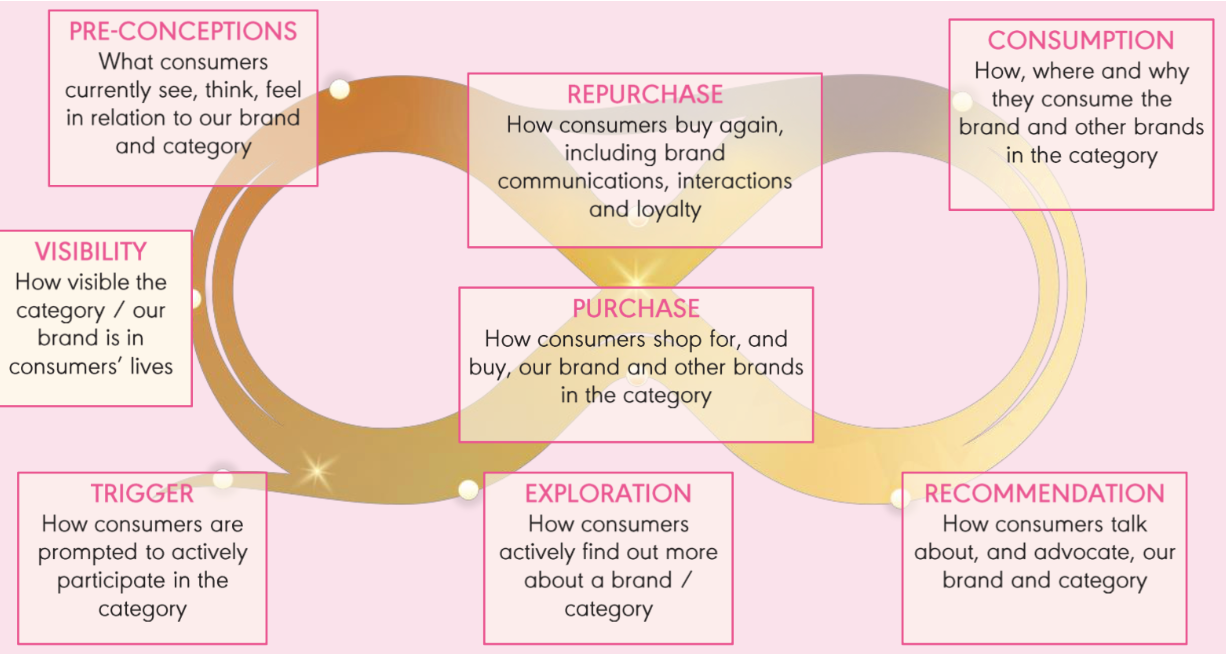
A person might see a brand in a friend’s story, forget it, encounter it again in a shop, explore it later through search, buy it impulsively, recommend it before they’ve even opened it, then loop back into exploration because a creator posts a review. The journey is fluid, circular and endlessly repeating — shaped by motivations, occasions, repertoires, fuels, frictions, cultural signals and context.
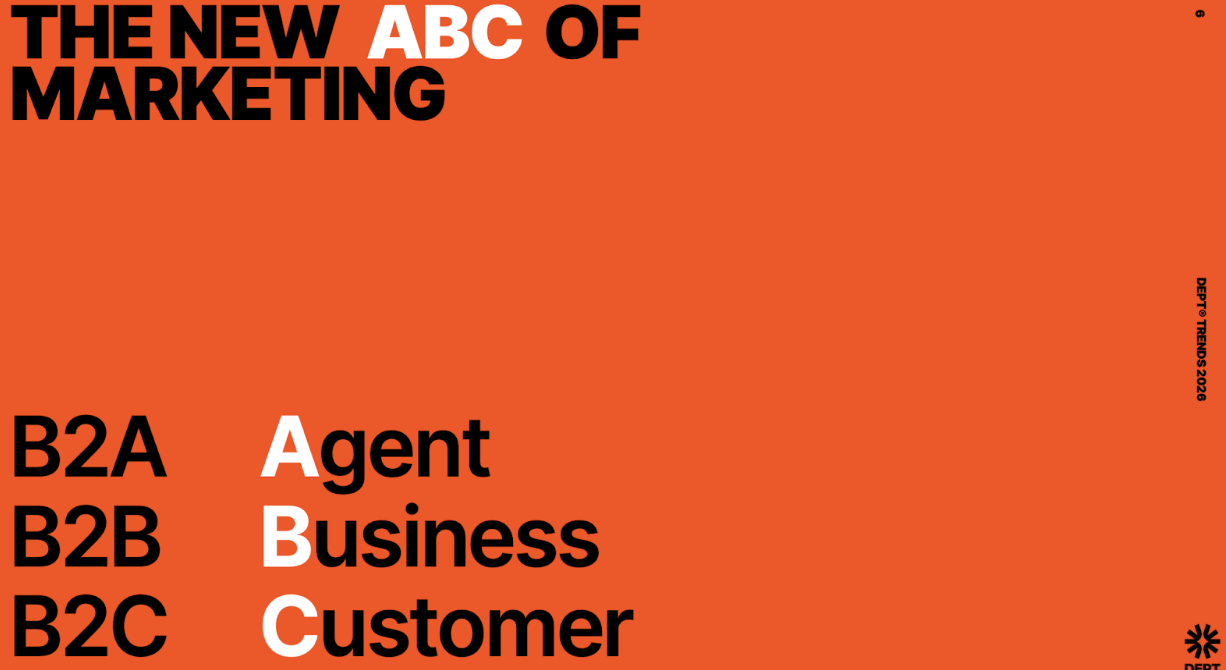
And now there’s a new layer: B2A — Business to Agents.
Brands must not only convince humans; they must convince AI agents — the copilots, ChatGPTs, Geminis and Claudes that increasingly mediate discovery, comparison and recommendation. As DEPT® highlights, growth is often decided before a human ever sees an ad, because agents pre‑filter what people encounter.
In this world of loops, noise and AI intermediaries, consistency becomes a superpower. Brands must be radically consistent across every touchpoint — human or machine — and stand for something emotionally meaningful and unmistakably unique. Consistency is what allows a brand to be:
- discoverable in chaotic ecosystems
- distinctive across thousands of micro‑touchpoints
- trusted by both humans and machines
- emotionally resonant in moments that matter
The theoretical funnel is dead.
The human journey is alive — circular, messy and mediated by machines.
And the marketers who master human unpredictability, data intelligence and creative distinctiveness to build consistent, distinctive, emotionally resonant brands will shape the future of both human and agent‑driven choice.